Monday, September 30, 2013

Fifty Shades of Several Gardens

I am not going to write about those books. I don't like them, I'm not interested in them and I don't care who got cast as the main characters in the movie.  If my daughter ever fell for a guy like that I would send her running for the hills.

So this isn't going to blog about that.

But my naturalist self loves the reproductive things bugs do -  and plants, and ducks, and goats and ...

Spiders


 Male orb weaver spiders are smaller and more nimble than females.

They spin less dramatic webs, and in general are less obtrusive. When people see them with females, they often tell me "there's a spider, with a little spider caught in its web", where the little spider is really a male.


In the fall, the female gets bigger still, as her abdomen plumps up to prepare for babies.

The female builds her orb and stays put.  This one was hanging out in my greenhouse, cleaning her feet with her mouthparts. Female spiders have a lot of time to hang out, clean up leftover dead bugs, and perfect their webs.

But if both sexes did that, spiders would never meet, and would soon die out.

So the males travel, moving from place to place until they find a willing female and begin their elaborate courtship.


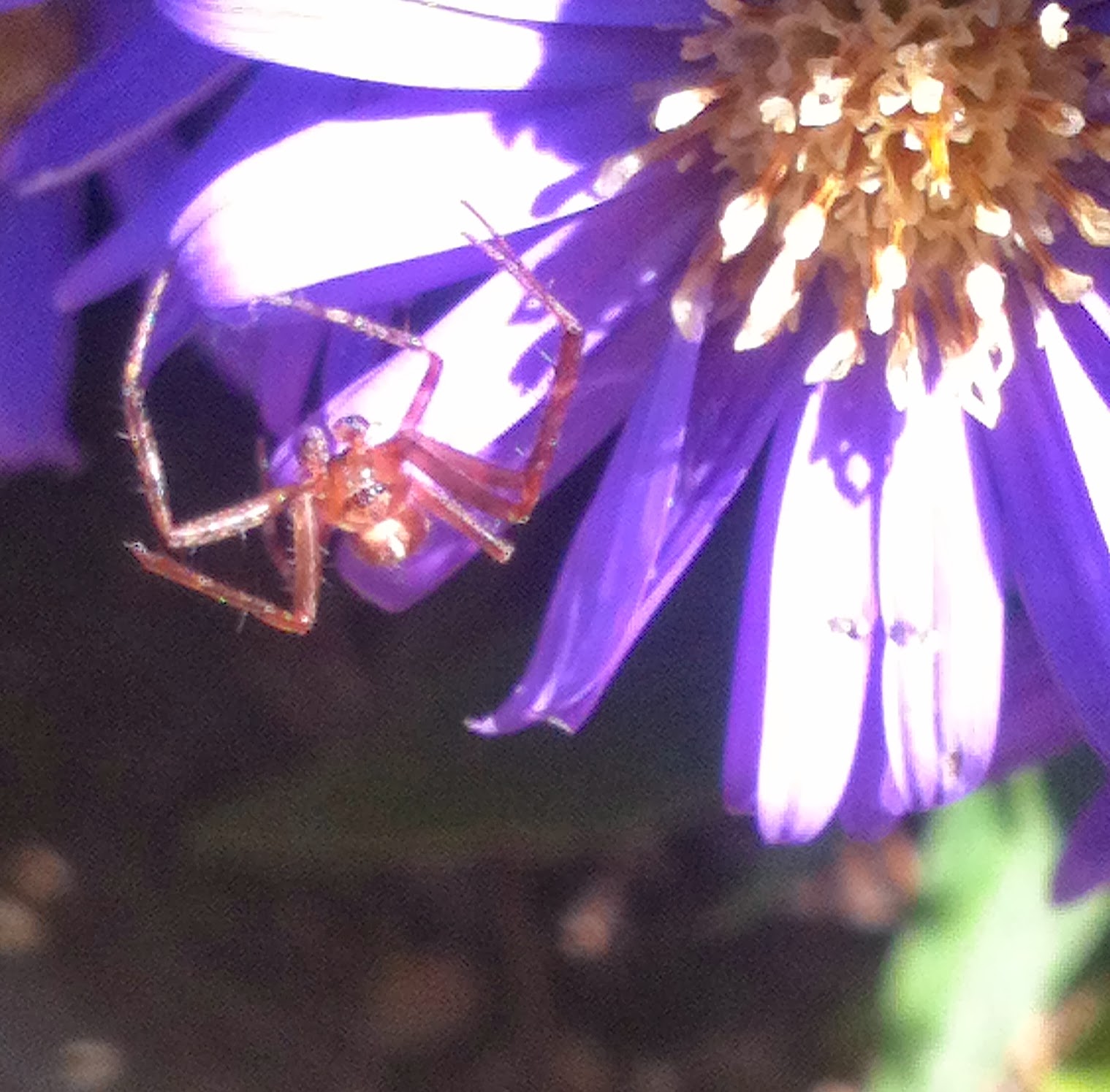
The male in this photo was crossing a single strand of silk to get to the female. She was hanging upside-down with her legs clutched in toward her body. She had swung down from her main web on a strand of her own silk, but he used his own silk to tie all of her limbs up before attempting to mate.

During her entire wait, the female was almost motionless. She neither attempted to eat the male, nor to help him out in any way. Once or twice, she adjusted a couple of legs as though they were uncomfortable, which they might have been, as this whole process took over an hour.


Mating is high stakes to a male spider. Any activity that needs the disclaimer "males of this species are usually not killed while doing this" should be an eye opener. This male was cautious, patient, but determined.

At some point, the male literally got the jitters and kept messing up his web and having to back up and start again. You can't see it in this crumby iPhone picture, but he's missing one front leg. Perhaps he had to learn the hard way that mating is delicate business, although a lot of spiders lose legs along the way. Finally he bound the females mouth parts so she wouldn't bite him, and the action began.

Spiders do not copulate. Instead the male produces a sperm packet which he takes in his mouth and places in the genital opening of the female.

Alas. My camera is also my phone. I wanted to hang around indefinitely peeping on this pair, but I had a call coming in that I had to deal with and I left without knowing whether the female ultimately ate her mate. I think probably not. She had plenty of fruit flies and anyway she seemed more intent on becoming fertilized than on eating.


Soldier beetles have so much less drama. The three in the foreground are two males and a female. If the male who is connected with the female drops off for some reason, she's got a handy replacement lined up and the other male gets a free ride while he waits.

Everywhere I looked the day I took this picture, there were more of these beetles, in groups of two, three or more, wandering around, eating and mating  and occasionally flying from flower to flower.


Regardless of what its shape may remind one of, a cucumber is female. It is after all the fertilized ovary of the plant.

Female flower with nascent cucumber attached


Cucumber plants have separate male and female flowers; only the female has a fruit below the flower. 


Pollen can only get from the male to the female flower by some third party - usually an insect.

Male flower - no cuke


You can buy seeds for cucumber varieties that are gynoecious - producing only female flowers. You then grow one plant with male and female flowers (monoecius) and the males on that plant pollenate everyone's female flowers. 


Or you can grow parthenocarpic cukes where each flower is a self-fertile female. Those seeds are expensive, so I tend to stick with the more old fashioned varieties.


Slugs are hermaphrodites. When they mate, each one fertilizes the other and is fertilized at the same time. Sometimes, one will chew off the other one's penis. It can't grow that back.

It requires patience for a human to watch slugs mating, but unlike with spiders, it is not because one partner is hesitant, but simply because anything slugs do takes time.

Banana slugs dangle from long trails of mucous when they mate. I've seen it and it's cool, but alas Several Gardens' Farm doesn't have any banana slugs.

I have already said all I plan to about the ducks in another postputting-duck-in-reproduction. Male ducks - ugg.


The goats are gearing up for their breeding season. Female goats can get pregnant for a few days every month from September through early January.


They let us know they are ready by bellowing, mounting each other, wagging their tails and rubbing themselves suggestively on inanimate objects.

Lightning has been high energy - and highly motivated by other goats - since she was a few weeks old. She liked play mounting her siblings; it probably (maybe?) has more to do with her high activity level than anything else.

I keep a buck rag in a jar to gauge how serious they are about actually breeding.

The rag smells very strongly of goat - even when they aren't in the mood, the girls are curious and sniff it in preference to food or attention.

But when she is receptive to the scent of a buck, she will immediately start licking her lips, dancing around and otherwise showing her interest.

Perhaps its just as well all these animals are getting energized in the rainy fall. All winter long their offspring - eggs hung in silken sacs, or deposited in the soil, seeds ripening in cucumbers carefully saved and left to become next year's plantings, embryonic goat twins - will grow and develop, getting ready for next spring.

I can hardly wait
A lover, not a fighter

Sunday, September 8, 2013

What's in the little fridge?

Meggie, our milk goat, is slowing down her lactation. Some mornings she's near her plateau level of two quarts. Other mornings, when she ate less or I milk her a bit earlier than normal, she may give as little as a quart.

There's never a day with more milk that there was a week prior. Meggie is storing more of the food as fat, and she needs to slim down. So - less food = less milk, and soon none - till next kidding.


We don't need the baby goats. They are cute but we have enough of our own. We don't need or want them for food, and selling them is scary. So if we can stretch out the time between new kids, we are all for it. 

Besides, at full production Meggie was giving 1 1/2 gallons of milk. Way more than our family needs.  

Over the past year, I've made a lot of cheeses. Some were great successes, some abject failures. A lot were in the middle somewhere, and many ended up in the cheese fridge to age.

We have a small mini fridge equipped with a little metal thermostat. Cheese ages at much warmer temperatures than food refrigeration - in the low 50's F (12 - 13 C). At this temperature, enzymes break down the fats and proteins into flavorful compounds, and beneficial molds and bacteria flourish on the cheese surface. 


The result ideally is rich ripe cheese. Alas, the world is not always ideal.  Sometimes we get corky, or overly salted, or otherwise less than perfect cheese. Sometimes I put these back to age longer. Aging can fix some problems, like bitter flavors. And out of sight, out of mind.

Unfortunately, out of sight but not out of nose range. The cheese fridge began to get pretty cheesy smelling. Even bries, Goudas and other mild cheese builds up a powerful punch in aggregate. 

Today, I cleaned the fridge. First I evacuated my husband and son from the room to avoid accusations of cheesing them to death. So there was no photographer and no pictures. You will have to imagine me lifting and sniffing each cheese, sorting them into keepers which we will eat on dessert plates in the coming weeks, and failed cheeses.

Then decontaminating every shelf, cranny and corner with water, baking soda, soap and vinegar, enjoying the fizziness and thinking it would never stop being cheesy.

I let the inside air dry for 24 hours and amazingly, it smells normal again.

And now I have a half sized fridge with nothing inside it.

Nature abhors a vacuum, and it's harvest time for early apples and pears.

Our standard sized apple trees are huge and covered with large numbers of apples but most of them are inedible due to scab, coddling moth or apple maggot.

So we are gradually adding some espaliered trees with scab resistant fruit, and which we can manage for pest control.

I bagged some of the apples with nylon footies. The apple maggot fly can't lay her eggs through the mesh, though sometimes coddling moths still do.


                                                                       Growing espaliers also lets us bring the trees closer to the house so we can just walk outside and pick fruit instead of making a trek back to the orchard.


Here are two apples on one branch, side by side, one with and one without a footie.


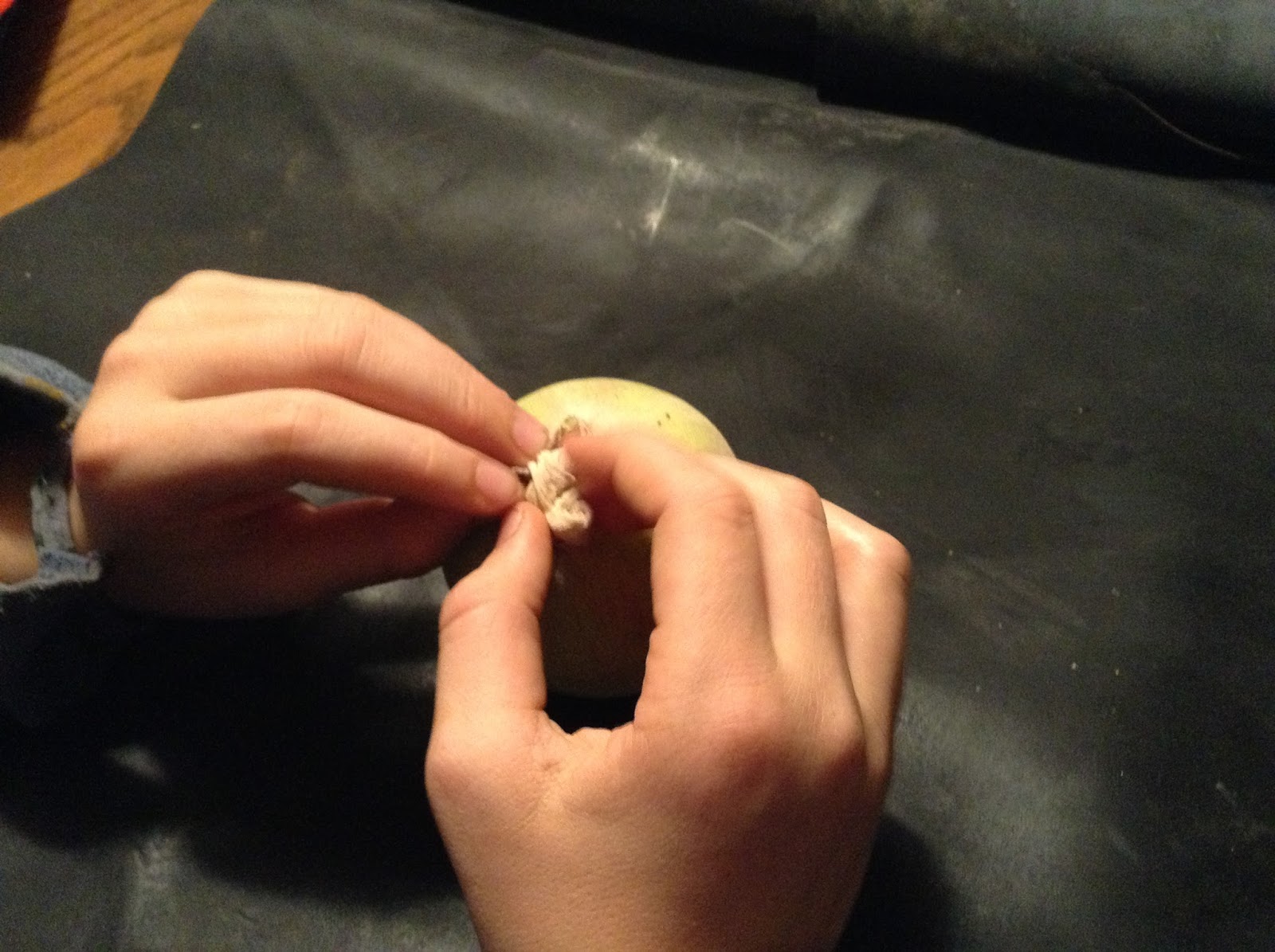
I had Noah unwrap one of the apples for me. It's slightly exciting, after watching them grow inside their little footies, to see how they will turn out.


And voila. 

An apple. 

Almost as big and almost as perfect as a conventionally raise apple from the store. 

A bit of a letdown. Until you take a bite and realize we grow for flavor here.


The apple on the right was grown inside a footie. It, and a couple dozen others with the same treatment, had zero apple maggot markings. A few had coddling moth worms inside. I'll need to find a better solution for that. But the footie is an almost complete maggot barrier.


You can see what happened to the one on the left, grown without protection. When you cut into it, you don't see a worm, just lots of discolored markings. I've been known to make sauce or cider from such apples, but I would have to be pretty hungry to eat one.

The picture below is what you see on the inside. Again, we grew these two apples side by side on the same tree. The only difference is a nylon footie covered the pretty one, the one riddled with dark markings was grown bare. This was one of those experiments that far outdid my expectations. I will bag every apple I can from now on. Putting out traps is less effective and the footies work so well there's no reason to even contemplate chemical sprays. I was sort of ashamed to even put the pristine bagged apple on a board next to its tarnished comrade.


Apples in the footies were slightly greener and less ripe than bare ones, but most varieties ripen off the tree.

All my pears, every one of them, has scabby skin. A bunch - maybe half, have coddling moths, which obviously prefer apples but aren't exclusive. But pears don't seem bothered by apple maggots at all. Scab on the skin can be peeled off, leaving pure, white pear underneath, perfectly good to eat.

Between the wrapped apples and the pears without coddling damage, I have plenty of fruit to fill my little fridge. We'll work our way through it, and hopefully it will all be gone by next spring when Meggie starts giving milk again.


shared on : frugal-days-sustainable-ways-89

Friday, August 30, 2013

Training tomatoes on a string


Seattle's summers are questionable for tomatoes.

Summer here is reliably dry, and almost generally sunny. But that weather often starts in late June or early July. And here it is, August 28th. The first rains have begun and the nights are closing in again.


Our growing season is short and our nights are almost always cool.

The typical tomato season is like this:


May 1: Plant tomatoes.

Tomatoes sit there for weeks.

Late June: Summer begins. Tomato plants take off.

July: Huge crop of green tomatoes on lush, sprawling plants. Gloat a bit.

August: first tomato ripens. Tomatoes begin shyly blushing red, one by one. I eat one, not quite ripe, pretending it is as rich and juicy as I want. Gloat a bit more.

Mid-August: real tomatoes. Never quite how David remembers them as a boy but plenty good enough.

End of August: first rain

Early September: all tomatoes succumb to late tomato blight.

I have taken to growing my tomatoes in a greenhouse. This year I planted them on red plastic mulch. This is supposed to reflect red light back into the plants and hasten ripening. It certainly helps suppress weeds.

Here are the plants when I poked them through the mulch, around mid-April.

The bricks are my path. They also absorb and release heat to help stablize the temperature from day to night.


Here is one of the plants poking up through the plastic.  

Very gently, I tie a piece of baling twine in a loose slip knot around the stem of each plant.

I use baling twine because it's abundant at Several Gardens Farm. I tie the twine loosely and in a slip knot because the plant will grow. I don't want the twine to choke it.

I tie the other end to the rafter of the greenhouse. 

If I didn't have a greenhouse I would build a support beam instead.


At some point the vines suddenly get energized and start growing. 

The vines put out many shoots in all directions, but if you follow the stem up from the ground you will see that it remains the principle 'trunk' all the way up and the other stems are side shoots.

If you let all the side shoots keep growing they will make lots of green tomatoes. Many will never ripen. 

If the plant is allowed to sprawl, many more will be eaten by slugs.


You must be brave and cut off all the side shoots. They are competing with the trunk for air and light. The plant will be fine and the tomatoes will be better without them. Really.


As summer progresses, gently wrap the stem around the twine. The stem is flexible but not very. Be careful not to break it. The goal is for the twine to support its weight so it can succeed in its upward journey.  

I think of the vine as leaning against the string. Every so often it would slip off if the string didn't keep wrapping around it.

You don't need to - and probably should avoid - elaborate topiary.

If the main stem happens to break, do not panic. The side shoot nearest the top will simply take over.


All summer, as the tomatoes grow, keep trimming off side shoots, gently wrapping the twine around the main stem, and checking to make sure the twine doesn't strangle the stem at any point. The tomatoes are heavy! Their weight could pull the stem till the twine cut into it, so you have to pay attention.

In mid-August, cut off the top of the main stem. After that, keep cutting any shoots that try to become the main stem. You don't want more tomatoes at this point. You want the ones you have to turn red.


Here is my row of tomatoes, like a chorus line, flaunting their ripening goodies.


I feel like I should offer some recipes, but most of mine are very simple.

Salted tomatoes:

Bring a salt shaker out to your tomato plant on a sunny day. Pick a warm tomato. Bite into it. Sprinkle each bite with salt. Eat the whole tomato, bite by bite, out in the sunshine.


Pizza soup:

Heat 1 T olive oil in a saucepan. 
Add 2 chopped garlic cloves. When they start to turn golden, add:
4 medium or 2 huge chopped tomatoes
Simmer till tomatoes are soft and juicy
Blend in blender till smooth
Add 1/8 tsp baking soda, 1/2 t oregano, 2 T chopped fresh basil and salt to taste
Blend another 60 seconds
Return to pot and heat to simmer
Just before serving, drizzle with 1 tsp additional olive oil and a light shredding of chopped basil

Serve with breadsticks and shredded cheese to sprinkle on the bowls. 


Shared on: from-the-farm-blog-hop-6 , frugal-days-sustainable-ways-88