Showing posts with label ducks. Show all posts

Friday, February 1, 2013

Putting the duck in reproduction

Baby runner ducks

Warning: this blog post contains graphic information about the duck reproductive cycle, which is somewhat brutal. Read with caution.

Also, FYI, I don't want to mention body parts by name because I think weird searches would start coming by my blog. So I'm trying to be prudent, not prudish.

Our first two ducks were female runners, Celia and Rosalind.


They looked identical until this year when Rosalind grew a cape of white around her shoulders. 


Now we can tell them apart, but they still spend most of their time as a pair.

Rosalind
Celia


Then we added Daisy. Daisy was up for trade at a barter event. We were sure someone else would want her, but at the end of the evening she was still there. The family offered her to us in exchange for a jar of honey. They just wanted her to have a home.
Daisy in her element


Daisy, getting ready to initiate
Despite a stressful evening in a cage at a party, then in a car, Daisy fit in immediately. The next morning, Celia and Rosalind were following her around and accepting her as their leader.      


Daisy has much stronger drives than the other two hens. She is louder, eats more, and can be frankly quite randy.

She would entice the other girls into the pond, climb on top of them and have her way with them.

Everyone seemed fine with this arrangement but Daisy was clearly the initiator.


When Pikachu joined them, he was stressed. His mate had been killed by a raccoon. His owners were moving and he had to go. He didn't seem to want to mingle with the other ducks.


But Daisy promptly staked him out as her mate. Ducks pair bond in the fall and winter, then mate with their partner in the spring, so they spend a fair amount of time courting.

She followed him around, head bobbing, steering him away from the other girls. He appeared more frightened than attracted by this, but over time he relaxed, got to know all the ducks, and became part of the group.


As duck mating season begins, Daisy and Pikachu appear to be a pair, and Rosalind and Celia are another.

Daisy and Pikachu spend a fair amount of time head bobbing and mating, mostly in the water. They are both heavy ducks and water is probably the most comfortable place for them. Daisy likes to know where Pikachu is all the time.

The two girls don't head bob or mate, but they escort each other around and like to be together to lay eggs.

But I also see Pikachu following each of the other girls around in the yard, usually while Daisy is swimming or laying an egg. Then when she gets back out into the yard, Daisy will come running at them, break it up, and the whole flock will go scuttling around at top speed for a few minutes before settling down to other activities.
Two pairs of ducks, with drama

I would sometimes see Daisy and Pikachu getting together but always in the water. But today he successfully caught up with one of the other ducks on land, and I saw and was flabbergasted.

The drake has a very long, very strange male part - in some species though possibly not mallards 40cm long - and twisty. Imagine a round yellow shoe lace twisted until it starts to form kinks, suddenly bursting out of the lower part of an otherwise tidy looking duck. I did not get a picture of it but you can probably figure out how  to google such an image. I also didn't try or even think of measuring and I don't apologize and won't go back and do it!

When Pikachu and Daisy were mating I didn't know this. I had seen other birds mate. Chickens, crows, etc. often join together at Several Garden's Farm and sometimes I happen to be there. Most male birds lack an external organ and join their vent to the vent of the female during fertilization. So I was doubly unprepared for what I saw.

It was pretty hard to miss this long, trailing yellow thing slashing out of his underside, snaking around the hen duck and into her vent. In a matter of seconds, the act was done. It then took a half minute or so to go back inside of him. Meanwhile he was waddling around, dragging it on the ground. The whole process - well  - it was disturbing.

In the wild, there are more male than female ducks, as females are much more likely to be on land where they are easy targets for predators. When the males outnumber the females too much, their behavior becomes quite aggressive. Groups of males that didn't find mates will chase down and forcibly copulate with females, often injuring and occasionally drowning them. Female ducks try to stay near their mates and avoid unfamiliar males.

What Pikachu was doing with the duck seemed to be somewhere between the consensual pair mating he does with Daisy and the forced copulation of unpaired wild mallard males.

The hen duck neither tried to prevent him, nor did she do any of the joyous courtship Daisy does.

It was like this: "Oh, there's Pikachu. I wonder if he's ..." And by that time it was all over and both parties are running to the pond to wash off.


If two females ducks are a pair, they guard each other, nest, and raise eggs together. But they need to go outside the pair to get the eggs fertilized. Pikachu should be happy to do this.

It gives him more ducks raising his babies. The hen ducks seem less enthusiastic. They would probably prefer a choice of males, and they need to go through a courtship to be in any way interested.


Being pair bonded appears to be a prerequisite for a female duck to respond favorably to a male. Studies have show that a female duck can deflect the fertilization process if she is unwillingly mated by a drake. She has a long, crooked reproductive tract that can contract and prevent fertilization. So all the head bobbing courtship benefits the male by priming his mate to accept his offering.

What can we learn from the ducks about how to conduct human affairs? Um - nothing.

I don't think we can look to ducks for role models. They are animals following instinct and maximizing their odds of a successful outcome.

I sometimes hear people pointing to one aspect of an animal's behavior: "Ducks form monogamous male/female pair bonds" and acting as though this means - "people should model themselves on ducks". This is not a great idea. First, because as we see, ducks really have much more room for behaviors than that.


Second, because you can find almost any behavior in the animal kingdom, so using animal models will lead you into some contradictory behaviors. And third because unlike ducks, we have deep cultural and ethical elements superimposed on our instincts.

Well - perhaps we can learn from ducks that a lot of impulses exist. We have to comb through and decide when to embrace nature and when not to, but it's hard to say that something is not natural if ducks do it.

We need to ask people-questions:

Is someone getting hurt? Is someone being exploited? Is everyone participating freely?

So, do we model ducks in:

  • opposite sex pair bond (why  not? every one's happy) 
  • same sex pair bond (why not? every one's happy) 
  • stepping outside the bond to mate (in this case some one's unhappy - iffy in human relations) 
  • mating rampantly for a few weeks and then taking the rest of the year off (clearly not every one's thing but not my business) 
  • male coercion of females (bad bad bad). 

duck print in the mud

Are ducks a great role model?

No.

Sorry, we'll have to keep thinking for ourselves.

shared on: farmgirl-friday-blog-hop-94simple-lives-thursday-132, the-backyard-farming-connection-hop-18frugal-days-sustainable-ways-64, the-wesnesday-fresh-foods-link-up-27


Saturday, January 5, 2013

Blossom by Blossom, Spring Begins

Late January and the dark is getting to us. The days are getting longer, but we are locked in shadow. The ducks ponds freeze at night. Goats really appreciate warm water to drink. They drink more of it, which is important for their urinary health and of course for milk production.

In the Pacific Northwest, the dominant season of the year is this winter/spring hybrid- endless, rainy, hinting at hopeful. Sometimes I think it starts in January with the first openings of midwinter flowers and ends in June when it finally stops raining for three glorious months.

All around Several Gardens Farm, in tiny ways, Spring is waking up.

The very first blossoming is the catkins of the filbert hedge. Filberts are wind pollinated, so they don't need to flower when the bees are active. Instead, their bare winter branches are suddenly alive with fuzzy, dangly "boy things". The female flowers are extremely subtle, but they are the part that will ripen into nuts later.

I could not get a good picture of the tiny, hot fuchsia female blossom, but here are the catkins.


Next comes the cornelian cherry dogwood. This brilliant yellow seems to be a special color - a way to start the season. Here are the fat, swelling flower buds against a grey sky.


The imposing camellias are getting ready to flower (later this month).

A single branch, with its waxy dark leaves and tissue paper flowers, is a centerpiece.

If you cut a branch while it's still in bud, the flowers that open inside are much paler pink than the ones that open outdoors.


You can make a very pretty arrangement by mixing the two of them.


But what about the edibles?

The artichoke is alive but beaten down by rain and freezing. When we get to our last frost date, I'll pull back all the tattered leaves. Strawberries are also looking pretty bad but in reality, gearing up for a comeback.


A stray habenero in the greenhouse. Pepper bushes love heat, and don't take off until the hottest part of summer. But once up, I find them remarkably tough, often surviving the mild freezes in our unheated greenhouse and limping into the next year still alive.

Any forgotten onions will provide tasty greens through our mild winters.


Cabbage gets sweeter with frost. So do Jerusalem artichokes. I dig up a few of them whenever I feel like it (which given how much work they are and how indifferent I am to them, is pretty rare).

 Arugula just keeps giving. This plant is the offspring of our summer crop. A few leaves at a time, it spices up salads all winter.


Miners' lettuce sprouts
The miners' lettuce and nasturtiums are not perennials, but they come back from seed every year.


Fava bean blossoms
These little miners' lettuce sprouts will self-thin to a couple of hardy plants. I think I'll do a story just for them when they're in season. They are pretty, tasty and easy to grow; winners in every way.


And ah, those pretty fava beans. I did not expect to find them in flower mid-January. Here's to pleasant surprises. They are usually grown as cover crops or as food, but they are semi-attractive ornamentals, and also have a lovely, waxy fragrance on warm evenings.

The oyster mushroom log has stopped putting out new growth but the old ones are still edible in soups and as flavoring, though too tough to enjoy on their own.

Of all the bee hives, the healthiest and most active is the Warre. If it stays this prosperous, expect to hear more about it in the coming year. But - it is the only hive with the full south facing exit and a wall behind it, so there may be extenuating circumstances.


 Winter is a good time to see the underlying structure of things.

The fat clusters of buds that stick out on fruit trees are the future blossoms. Thin buds that cling tightly to the stem hold leaves. You need both, so careful not to winter prune away all of your next year's fruit!


Winter or early Spring is when you check your espaliers for shape.I apologize for the clutter in this picture, but hopefully you can see that the tree is growing nicely - balanced branches starting to put out little side spurs where apples will form.


 And who isn't grateful for the Bergenia and the Beauty Berry for giving color at this time of year. I ask nothing else of them, but simply give thanks.


Friday, December 21, 2012

A tale of two boots

In Seattle's rainy December it's easy to forget that I ever felt sun on my face. The nights are long, the sun low in the southern sky during its brief visits, even at noon. At least some part of nearly every day, we get rain, sleet or falling slush.

The goats and the chickens feel about as excited as I do. Lightning is afraid of the dark, Jeannette  sleeps the day away. Meggie is stoical, as she so often is. The chickens find dry spots and just hunker down in them, occasionally foraging for the abundant worms that rise up out of the saturated ground.

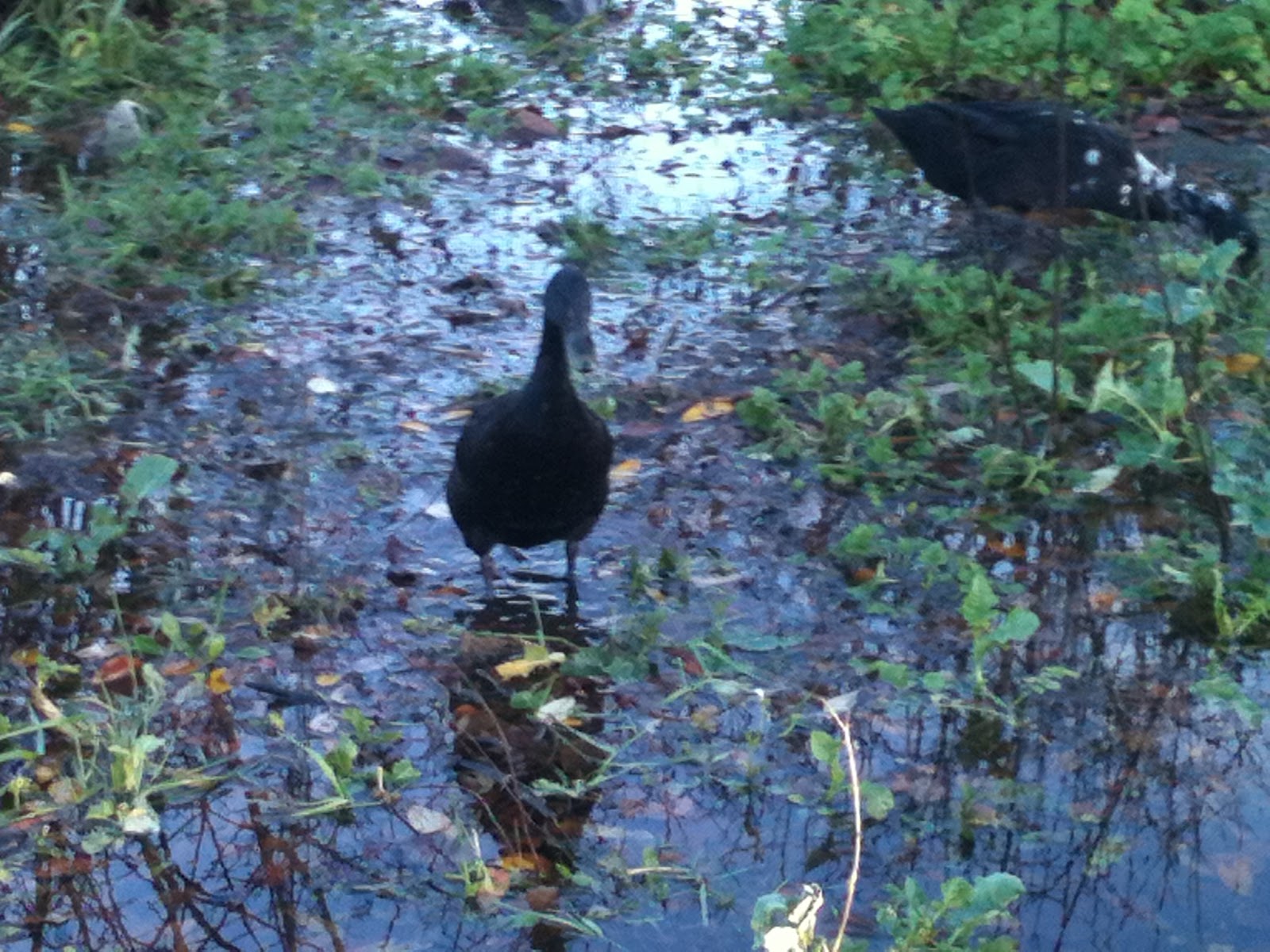
The ducks, bless them, love this weather. 


They live for water, and their coats resist all attempts to dampen or chill. The back of the yard is under water.


Areas are barely submerged and swampy, others deep enough for them to swim around. They dabble about, fishing up sluggies and worms and unfortunate beetles that didn't get out before the rains. 

One night, they refused to come in. Maybe they would have been safe. Most predators would be less skilled in the water than they are, but I've lost ducks to raccoons before and I was taking no chances. Out I ran, boots sinking in the muck, to round them up.


By the time I got them all to bed, my feet were encased in big gray rubber bags of wet.

I drained my boots, blotted them out with a towel, set them in the mudroom and went to bed. Predictably, the next day they were as damp as ever.

I have a very good rapport with a wide circle of facebook friends. When my boots get wet, I tell people, and they make suggestions. There were two main schools of thought:


  1. Stuff dry, crumpled newspaper into the boots to absorb the water
  2. Let air circulate through the boots - doing nothing to obstruct the rapid flow of moist air out

People did not agree which method was better, and speculated at length. Both groups agreed I should do an experiment to see who was right.

My Experiment:

I filled both boots to the tops with water. I left them for ten minutes, to fully saturate any crevices. Then I held each boot by the heel and drained it for five minutes. 
two boots full of water, marinating in the sink

I weighed both boots. I assumed they both held as much water as they could and the difference was boot weight not water weight. I do not know if this was correct - it was an educated guess, I suppose.

I stuffed one boot loosely with newspaper, left the other one empty, and placed both on their sides, with their open tops directed at our heat register. 

I changed the newspaper at 12 hour intervals for 72 hours. I weighed the boots every 24 hours and at the end of the experiment. 

There are some problems with this setup. I wish I had weighed the boots at 4 hour increments for the first day. Perhaps I missed differences early on.

And I did not have an elegant way to determine whether the boots were bone dry at the end.


My Results:

Saturated weight
Weight – 24 hours
Weight – 48 hours
Weigh - 72 hr
Weight lost
Boot 1
 684
 636
 633
 632
 52 g
Boot 2
 635
 586
 585
 585
 50 g

I have forgotten how to determine if a number is statistically significant. Maybe someone out there can analyze this data for me.

My Conclusion:

To me, the results suggest that either method works equally well.  This was slightly surprising because the newspaper I removed the first day was quite damp. I expected it to have removed water from the boot, but evidently a similar amount evaporated from the other one.

Discussion:

What was interesting about this test, was that all of my friends, who had pretty strong opinions on which method would be better, were content to give up their theory if it proved incorrect. It was fun, and the stakes were low enough that they could comfortably admit defeat.

We need to be like this more often. We have to make real life decisions, sometimes analyzing evidence that is incomplete. I'm thinking about gun violence right now, but a week ago, before the horror in Connecticut, I would have been thinking of climate change, or the economy, or any of a number of real things that generate a lot of heated disagreement. In these situations, as surely as in the frivolous story of my boots, it is not important to enter an argument being right - it's important to be right in the conclusion. If this means abandoning old beliefs in the face of new evidence, so be it.

I shouldn't defend a position because it's "mine" but because I've thought about it and tested it in whatever way I can. I should welcome and listen to opposing ideas, and if they are right, I should adopt them. This is important to learn in lighthearted, silly moments, so that we can do it when it matters and is harder.


Of course, we have values, about the worth of life, the value of freedom, and our relationship to entities greater than ourselves. These values exist outside the realm of these inquiry. But they should also stand aside when we use inquiry to settle questions of fact.

Above all, we need to base our decisions on what we honestly conclude to be the case - not on what we hope, or what doesn't interfere with our plans, or what we inherited as belief systems from the past.


Regardless of our opinions, we need to spend time making sure they are actually correct.

Otherwise, we are sillier than a bunch of ducks.
    shared on: frugal-days-sustainable-ways