Showing posts with label cornelian cherry. Show all posts

Saturday, January 5, 2013

Blossom by Blossom, Spring Begins

Late January and the dark is getting to us. The days are getting longer, but we are locked in shadow. The ducks ponds freeze at night. Goats really appreciate warm water to drink. They drink more of it, which is important for their urinary health and of course for milk production.

In the Pacific Northwest, the dominant season of the year is this winter/spring hybrid- endless, rainy, hinting at hopeful. Sometimes I think it starts in January with the first openings of midwinter flowers and ends in June when it finally stops raining for three glorious months.

All around Several Gardens Farm, in tiny ways, Spring is waking up.

The very first blossoming is the catkins of the filbert hedge. Filberts are wind pollinated, so they don't need to flower when the bees are active. Instead, their bare winter branches are suddenly alive with fuzzy, dangly "boy things". The female flowers are extremely subtle, but they are the part that will ripen into nuts later.

I could not get a good picture of the tiny, hot fuchsia female blossom, but here are the catkins.


Next comes the cornelian cherry dogwood. This brilliant yellow seems to be a special color - a way to start the season. Here are the fat, swelling flower buds against a grey sky.


The imposing camellias are getting ready to flower (later this month).

A single branch, with its waxy dark leaves and tissue paper flowers, is a centerpiece.

If you cut a branch while it's still in bud, the flowers that open inside are much paler pink than the ones that open outdoors.


You can make a very pretty arrangement by mixing the two of them.


But what about the edibles?

The artichoke is alive but beaten down by rain and freezing. When we get to our last frost date, I'll pull back all the tattered leaves. Strawberries are also looking pretty bad but in reality, gearing up for a comeback.


A stray habenero in the greenhouse. Pepper bushes love heat, and don't take off until the hottest part of summer. But once up, I find them remarkably tough, often surviving the mild freezes in our unheated greenhouse and limping into the next year still alive.

Any forgotten onions will provide tasty greens through our mild winters.


Cabbage gets sweeter with frost. So do Jerusalem artichokes. I dig up a few of them whenever I feel like it (which given how much work they are and how indifferent I am to them, is pretty rare).

 Arugula just keeps giving. This plant is the offspring of our summer crop. A few leaves at a time, it spices up salads all winter.


Miners' lettuce sprouts
The miners' lettuce and nasturtiums are not perennials, but they come back from seed every year.


Fava bean blossoms
These little miners' lettuce sprouts will self-thin to a couple of hardy plants. I think I'll do a story just for them when they're in season. They are pretty, tasty and easy to grow; winners in every way.


And ah, those pretty fava beans. I did not expect to find them in flower mid-January. Here's to pleasant surprises. They are usually grown as cover crops or as food, but they are semi-attractive ornamentals, and also have a lovely, waxy fragrance on warm evenings.

The oyster mushroom log has stopped putting out new growth but the old ones are still edible in soups and as flavoring, though too tough to enjoy on their own.

Of all the bee hives, the healthiest and most active is the Warre. If it stays this prosperous, expect to hear more about it in the coming year. But - it is the only hive with the full south facing exit and a wall behind it, so there may be extenuating circumstances.


 Winter is a good time to see the underlying structure of things.

The fat clusters of buds that stick out on fruit trees are the future blossoms. Thin buds that cling tightly to the stem hold leaves. You need both, so careful not to winter prune away all of your next year's fruit!


Winter or early Spring is when you check your espaliers for shape.I apologize for the clutter in this picture, but hopefully you can see that the tree is growing nicely - balanced branches starting to put out little side spurs where apples will form.


 And who isn't grateful for the Bergenia and the Beauty Berry for giving color at this time of year. I ask nothing else of them, but simply give thanks.


Monday, August 27, 2012

Best tree you've never heard of

Gloria admiring the late January flowers
Cornelian cherry is popular with writers of antiquity and the middle ages. Their fruit was fed to pigs by Circe, preserved like olives by a Columella; their wood was turned to spears by Romulus. No monastery was complete without one.

All that has been forgotten. They are now delegated to the obscure ranks with the elderberry, loquat, medlar and Saskatoon - cool fruit that someone, somewhere once ate, but what does that have to do with us?

Why has no one heard of Cornus mas, also known as the cornelian cherry, or cornelian dogwood? Your guess is as good as mine. This tree has it all.

Cornelian dogwood flowers in late January to February, ahead of the forsythia and the Camellia. Its little yellow flowers are a treat to look at and a life saver for any pollinating insects that happen to be active at that unusual time of year.


Our tree is large for the species, most are multi-trunked, large shrubs. The wood is slender and tough; sprouting wood is very straight. We gave some to a friend who made drum sticks from it. Shoots have been used for wagon spokes and weapons. I think they would make good magic wands, conferring to the wizard the beauty, tenacity and generosity of the tree.


The whole tree is covered with fruit.


Come summertime,  the whole tree covers itself with fruit. Because it does not all ripen at once, the weeks leading up to harvest are gorgeous, with yellow, orange, red and maroon fruit studding the tree like multi colored lights.

The cornelian cherry is not a true cherry. The picture to the right shows a branch without fruit -the leaves are opposite at each node.

This cherry is a dogwood! Compared to real cherries, this fruit has a much later harvest time.

Ours is ready in late August. I've seen one at Kubota Gardens http://www.kubota.org/ that's about three weeks later. I've also seen them at Seattle Center, near the Armory. It is beginning to ripen right now, as of August 27.

Cornelian cherries are native to Eastern Europe and Western Asia. When you see a jar of "cherry" jam in a Turkish deli, it may really be from these fruit.

You want to pick cornelian cherries at the peak of ripeness. Wait until they are deep, maroon red, and gently pinch one. It should be slightly soft between your fingers. If you pick one too early, you will know the moment it goes in your mouth. They are astringent, puckery and frankly, you will never want another one.
Breath. It wasn't ripe. Try a darker one.


The flavor should be sweet with a hint of sour around the pit, aromatic profiles of banana and pear and a moist, slightly mealy texture. They are ok for fresh eating - but you are probably harvesting plums, blackberries and raspberries right now - the very finest fresh fruits of the year. Cornelian cherries shine in preserves, jam and other winter treats.

Risky but speedy way to remove pits
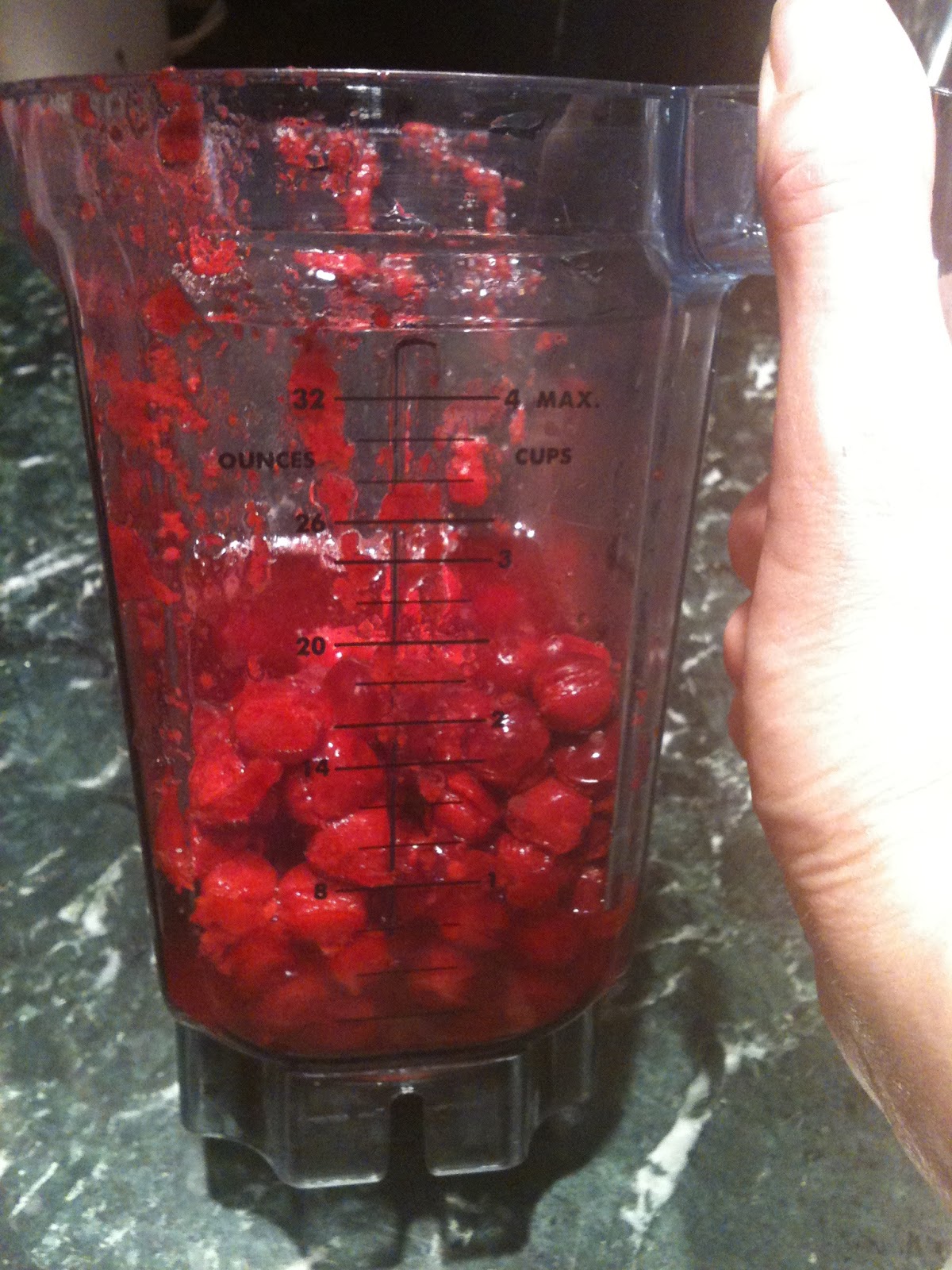
Like cherries, each fruit has a single pit - much harder to remove than a cherry's. The pitter your mom got you won't work - neither will a hairpin. The three ways I know to pit cornelian cherries are by putting them in your mouth and sucking the fruit from around the stone, by running them through a blender at the lowest setting and hoping a stone does not break the blade, or by boiling them and then straining through a chinoise. Perhaps this pit removal challenge is why they are not more common.
Once pitted, the pulp is good to go.

You can use it in any jam recipe, or freeze the pulp and bake it into pies, danish pastry, or anywhere you would use cherries or other summer fruit. I make a jam by boiling equal weights of pitted fruit and sugar with one teaspoon citric acid per quart of fruit. Once it reaches boiling I cook for 6 minutes, then pour it into hot jars, seal, and bring to boil in a water bath for ten minutes. This makes a soft, sauce-like jam. The jam will not reach its full, bright red color without added acid. Like many red foods, it discolors to a grayish purple if its pH gets to high.

Once the cornelian cherry passes its ripened prime, it is one of the fastest fruits to ferment. I would love a wine making friend to come experiment with some fully ripe specimens. They might make good natural-yeast wine, and almost certainly they would do well with any recipe.

Every year, we harvest four or five gallons of fruit. This represents maybe a tenth of the tree's total contribution. We simply can't eat it all. We share what we can with other people, because we know what happens to the rest. As the fruit ferments, first on the tree and then falling to the ground below, the ducks, wasps, goats and chickens move in for the big party.

There is plenty of evidence, in the form of raccoon and bird leavings, that wildlife gets in on the bounty as well.

We don't mind having a mixed bunch of happy animals crashed on our lawn, but man are they grumpy the next day. Until they go back for a little "hair of the dogwood"