Showing posts with label pollen. Show all posts

Saturday, January 5, 2013

Blossom by Blossom, Spring Begins

Late January and the dark is getting to us. The days are getting longer, but we are locked in shadow. The ducks ponds freeze at night. Goats really appreciate warm water to drink. They drink more of it, which is important for their urinary health and of course for milk production.

In the Pacific Northwest, the dominant season of the year is this winter/spring hybrid- endless, rainy, hinting at hopeful. Sometimes I think it starts in January with the first openings of midwinter flowers and ends in June when it finally stops raining for three glorious months.

All around Several Gardens Farm, in tiny ways, Spring is waking up.

The very first blossoming is the catkins of the filbert hedge. Filberts are wind pollinated, so they don't need to flower when the bees are active. Instead, their bare winter branches are suddenly alive with fuzzy, dangly "boy things". The female flowers are extremely subtle, but they are the part that will ripen into nuts later.

I could not get a good picture of the tiny, hot fuchsia female blossom, but here are the catkins.


Next comes the cornelian cherry dogwood. This brilliant yellow seems to be a special color - a way to start the season. Here are the fat, swelling flower buds against a grey sky.


The imposing camellias are getting ready to flower (later this month).

A single branch, with its waxy dark leaves and tissue paper flowers, is a centerpiece.

If you cut a branch while it's still in bud, the flowers that open inside are much paler pink than the ones that open outdoors.


You can make a very pretty arrangement by mixing the two of them.


But what about the edibles?

The artichoke is alive but beaten down by rain and freezing. When we get to our last frost date, I'll pull back all the tattered leaves. Strawberries are also looking pretty bad but in reality, gearing up for a comeback.


A stray habenero in the greenhouse. Pepper bushes love heat, and don't take off until the hottest part of summer. But once up, I find them remarkably tough, often surviving the mild freezes in our unheated greenhouse and limping into the next year still alive.

Any forgotten onions will provide tasty greens through our mild winters.


Cabbage gets sweeter with frost. So do Jerusalem artichokes. I dig up a few of them whenever I feel like it (which given how much work they are and how indifferent I am to them, is pretty rare).

 Arugula just keeps giving. This plant is the offspring of our summer crop. A few leaves at a time, it spices up salads all winter.


Miners' lettuce sprouts
The miners' lettuce and nasturtiums are not perennials, but they come back from seed every year.


Fava bean blossoms
These little miners' lettuce sprouts will self-thin to a couple of hardy plants. I think I'll do a story just for them when they're in season. They are pretty, tasty and easy to grow; winners in every way.


And ah, those pretty fava beans. I did not expect to find them in flower mid-January. Here's to pleasant surprises. They are usually grown as cover crops or as food, but they are semi-attractive ornamentals, and also have a lovely, waxy fragrance on warm evenings.

The oyster mushroom log has stopped putting out new growth but the old ones are still edible in soups and as flavoring, though too tough to enjoy on their own.

Of all the bee hives, the healthiest and most active is the Warre. If it stays this prosperous, expect to hear more about it in the coming year. But - it is the only hive with the full south facing exit and a wall behind it, so there may be extenuating circumstances.


 Winter is a good time to see the underlying structure of things.

The fat clusters of buds that stick out on fruit trees are the future blossoms. Thin buds that cling tightly to the stem hold leaves. You need both, so careful not to winter prune away all of your next year's fruit!


Winter or early Spring is when you check your espaliers for shape.I apologize for the clutter in this picture, but hopefully you can see that the tree is growing nicely - balanced branches starting to put out little side spurs where apples will form.


 And who isn't grateful for the Bergenia and the Beauty Berry for giving color at this time of year. I ask nothing else of them, but simply give thanks.


Friday, June 22, 2012

Meet the wasps

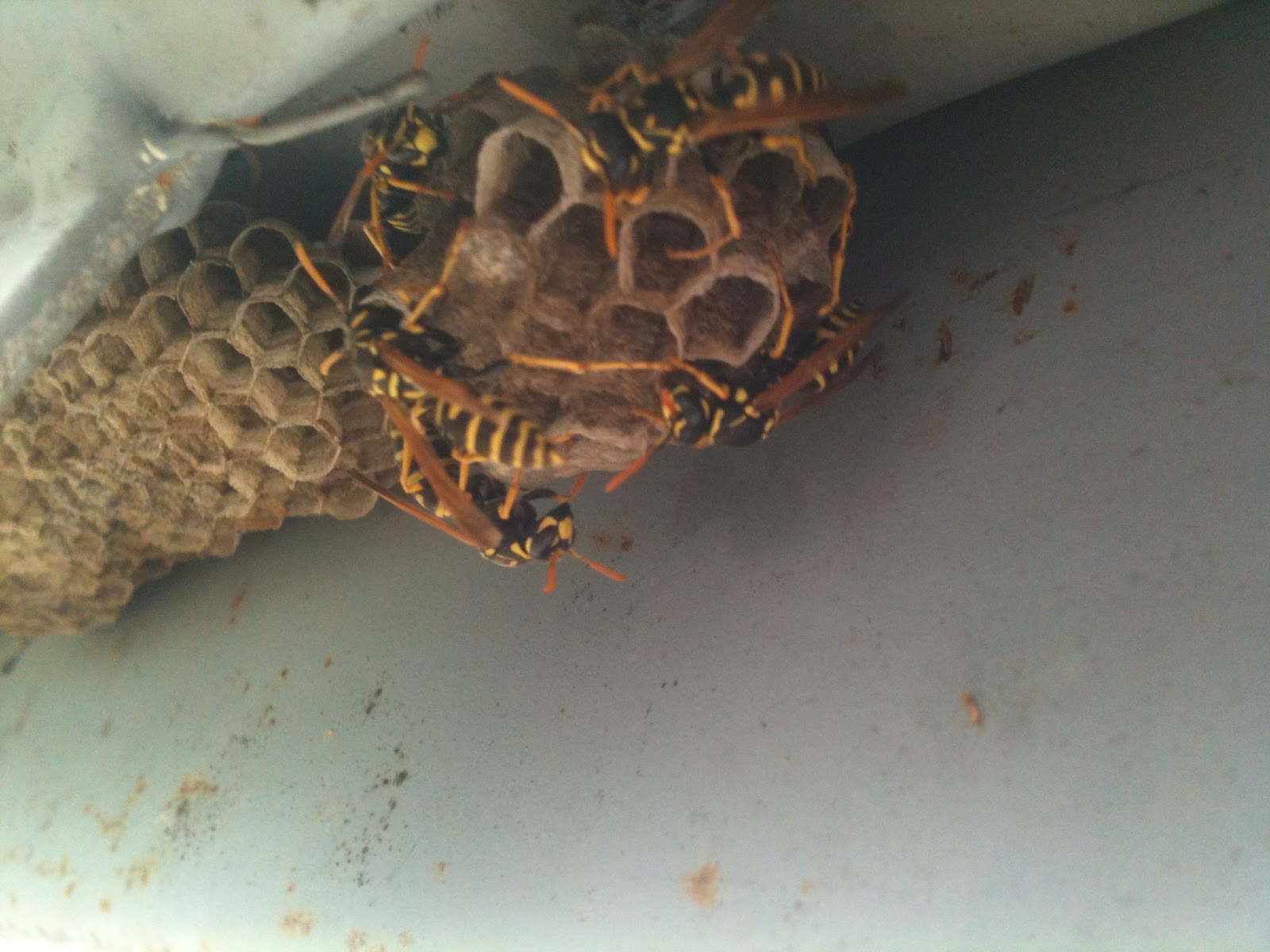
A tiny colony - right, and last year's abandoned cells to right 
 My favorite way to kill time is watching the paper wasp colony in the greenhouse. Several gardens farm is home to many kinds of wasp, from parasites that eat our aphids, to bald faced hornets that hunt down and destroy flies on the wing.

The only wasps that have ever given us trouble are the yellow jackets. I was once stung by them, when I accidentally mowed their colony's exit site.

That wasn't really their fault, but we have other problems with them.  We trap and destroy them to protect the bees.

The greenhouse wasps are a different species, some kind of Polistes or paper wasp.


The greenhouse - favorite building spot

Paper wasps look similar to yellow jackets, but with longer, reddish antenna and narrower bodies. They build open celled paper nests on sheltered spots a few meters above the ground. They build new nests each year, but they strongly favor certain sites and like to rebuild there. In the nest below, they built new cells right next to an abandoned nest built by a different colony last year. They simply will not reuse!
Closer view of the colony.


The colony pictured was one of several built in the west eves of the greenhouse. For reasons of their own, the wasps usually build in the west side of structures.  This picture was taken on a cold, rainy day, when few insects were flying. I'm guessing the wasps shown represent 75% of the whole population. A tiny colony, where every worker matters. No wonder they are reluctant to take risks, like flying out to sting me. Not complaining, mind you.

On sunny days, the wasps wander around inside the greenhouse or fly out through the vents to gather their favorite food - caterpillars and other insects. These wasps are part of our pest management system.

Achocas (green) were pollinated by wasps last  season
They serve another role as well. They are our greenhouse pollinators. Paper wasps are not known as pollen distributors, but I've seen plenty of them on flowers, drinking nectar. Though they do not have furry bodies, the better to transport pollen granules, their smooth skins seem to hold enough of it that last year I have a great crop of achocha squash, which has separate male and female flowers, and relies on insects to bring their parts together. Only the wasps had access to the greenhouse where I grew these squash, so I am almost certain they were the pollen distributors. Perhaps one day they will be used commercially?


Paper wasps have small colonies compared to yellow jackets, honey bees or bumble bees. On sunny days, there may be just a handful of insects at the nest, with everyone else out hunting. I have not spent enough time with the colony to know for sure whether the same couple of wasps is always at home, or whether they take turns. I guess the next step would be to color mark them and see. I'm still a little too shy to try that.


Being a queen wasp is a little more flexible than being a queen bee. In the fall, the wasps born near the end of the season are big, plump, and exceptionally well fed. The females of this group mate, and then go into sheltered spots to hibernate till spring. They found, populate and provision colonies in spring, and thus each one could be a queen. But in reality, several often share the same nest, and even take turns hunting and laying eggs until one gradually pushes the others out of the role of queen. Or if one has more viable eggs, her daughters may help her suppress the others.

I have stood under colonies, sometimes for half an hour or longer, and never been bothered by the wasps. I've stood right next to them while they gathered wood, chewing splinters off our fence and stashing them in their gullets. They take the wood home, chew it up, and turn it into paper. If I offered them colorful material, they might make pinatas. I haven't experimented with that.

I've watched one lay eggs - a sweet, domestic sight. When I was taking pictures, I was a typical noise, clumsy, human, and jarred the nest a couple of times.  The wasps did come out and menace me. One even flew a few centimeters, landed on an eve, and crouched in a threatening manner, but didn't approach or try to sting.. I haven't pushed my luck further than that. I know that bees hives seem to retain memories of individual people for weeks or months, and I don't want to find out that wasps do too. At least, not bad memories.