Showing posts with label filbert. Show all posts

Saturday, January 5, 2013

Blossom by Blossom, Spring Begins

Late January and the dark is getting to us. The days are getting longer, but we are locked in shadow. The ducks ponds freeze at night. Goats really appreciate warm water to drink. They drink more of it, which is important for their urinary health and of course for milk production.

In the Pacific Northwest, the dominant season of the year is this winter/spring hybrid- endless, rainy, hinting at hopeful. Sometimes I think it starts in January with the first openings of midwinter flowers and ends in June when it finally stops raining for three glorious months.

All around Several Gardens Farm, in tiny ways, Spring is waking up.

The very first blossoming is the catkins of the filbert hedge. Filberts are wind pollinated, so they don't need to flower when the bees are active. Instead, their bare winter branches are suddenly alive with fuzzy, dangly "boy things". The female flowers are extremely subtle, but they are the part that will ripen into nuts later.

I could not get a good picture of the tiny, hot fuchsia female blossom, but here are the catkins.


Next comes the cornelian cherry dogwood. This brilliant yellow seems to be a special color - a way to start the season. Here are the fat, swelling flower buds against a grey sky.


The imposing camellias are getting ready to flower (later this month).

A single branch, with its waxy dark leaves and tissue paper flowers, is a centerpiece.

If you cut a branch while it's still in bud, the flowers that open inside are much paler pink than the ones that open outdoors.


You can make a very pretty arrangement by mixing the two of them.


But what about the edibles?

The artichoke is alive but beaten down by rain and freezing. When we get to our last frost date, I'll pull back all the tattered leaves. Strawberries are also looking pretty bad but in reality, gearing up for a comeback.


A stray habenero in the greenhouse. Pepper bushes love heat, and don't take off until the hottest part of summer. But once up, I find them remarkably tough, often surviving the mild freezes in our unheated greenhouse and limping into the next year still alive.

Any forgotten onions will provide tasty greens through our mild winters.


Cabbage gets sweeter with frost. So do Jerusalem artichokes. I dig up a few of them whenever I feel like it (which given how much work they are and how indifferent I am to them, is pretty rare).

 Arugula just keeps giving. This plant is the offspring of our summer crop. A few leaves at a time, it spices up salads all winter.


Miners' lettuce sprouts
The miners' lettuce and nasturtiums are not perennials, but they come back from seed every year.


Fava bean blossoms
These little miners' lettuce sprouts will self-thin to a couple of hardy plants. I think I'll do a story just for them when they're in season. They are pretty, tasty and easy to grow; winners in every way.


And ah, those pretty fava beans. I did not expect to find them in flower mid-January. Here's to pleasant surprises. They are usually grown as cover crops or as food, but they are semi-attractive ornamentals, and also have a lovely, waxy fragrance on warm evenings.

The oyster mushroom log has stopped putting out new growth but the old ones are still edible in soups and as flavoring, though too tough to enjoy on their own.

Of all the bee hives, the healthiest and most active is the Warre. If it stays this prosperous, expect to hear more about it in the coming year. But - it is the only hive with the full south facing exit and a wall behind it, so there may be extenuating circumstances.


 Winter is a good time to see the underlying structure of things.

The fat clusters of buds that stick out on fruit trees are the future blossoms. Thin buds that cling tightly to the stem hold leaves. You need both, so careful not to winter prune away all of your next year's fruit!


Winter or early Spring is when you check your espaliers for shape.I apologize for the clutter in this picture, but hopefully you can see that the tree is growing nicely - balanced branches starting to put out little side spurs where apples will form.


 And who isn't grateful for the Bergenia and the Beauty Berry for giving color at this time of year. I ask nothing else of them, but simply give thanks.


Saturday, September 1, 2012

Harvesting the hazels


You need to stop reading this and go outside right now. Find the nearest hazel or filbert hedge, and break off one of the clusters of nuts.

Hazelnut in the husk
If you live in the Pacific northwest, it won't be hard to find one. Any planting with trees and shrubs probably has a few. If you live elsewhere, you might have to search. That's ok. The journey is what matters, right?


If you don't break of this cluster, the squirrels will in a matter of days, so don't feel too guilty. Of course, don't do anything that will get you in trouble, either!

The cluster of hazelnuts in their cases will be jade green and frilly, a group of lacey collars enclosing green or tan seeds. Put a thumb on the tannest nut, and try to move it. If it roles free from the husk, it's ripe enough to eat, though perhaps not for long-term storage. If not, it doesn't matter for what you are going to do. Peel back the husk instead.

Insert nose here
Now smell the husk, and the green stem of the nut. Isn't it divine? It could be a mens' or womens' cologne, or a laundry product, but it's too pure really for either. It smells like, of all things, spring. Funny in early September.


I have no idea why hazelnut husks smell so wonderful. Maybe to help attract squirrels? Though they consume many nuts, squirrels greatly benefit the few that survive. By dragging them off and burying them, squirrels serve as the distribution system for the seeds, allowing them to grow far from the tree. That is idle speculation, though. Seriously I have no clue. But seriously, they smell great.


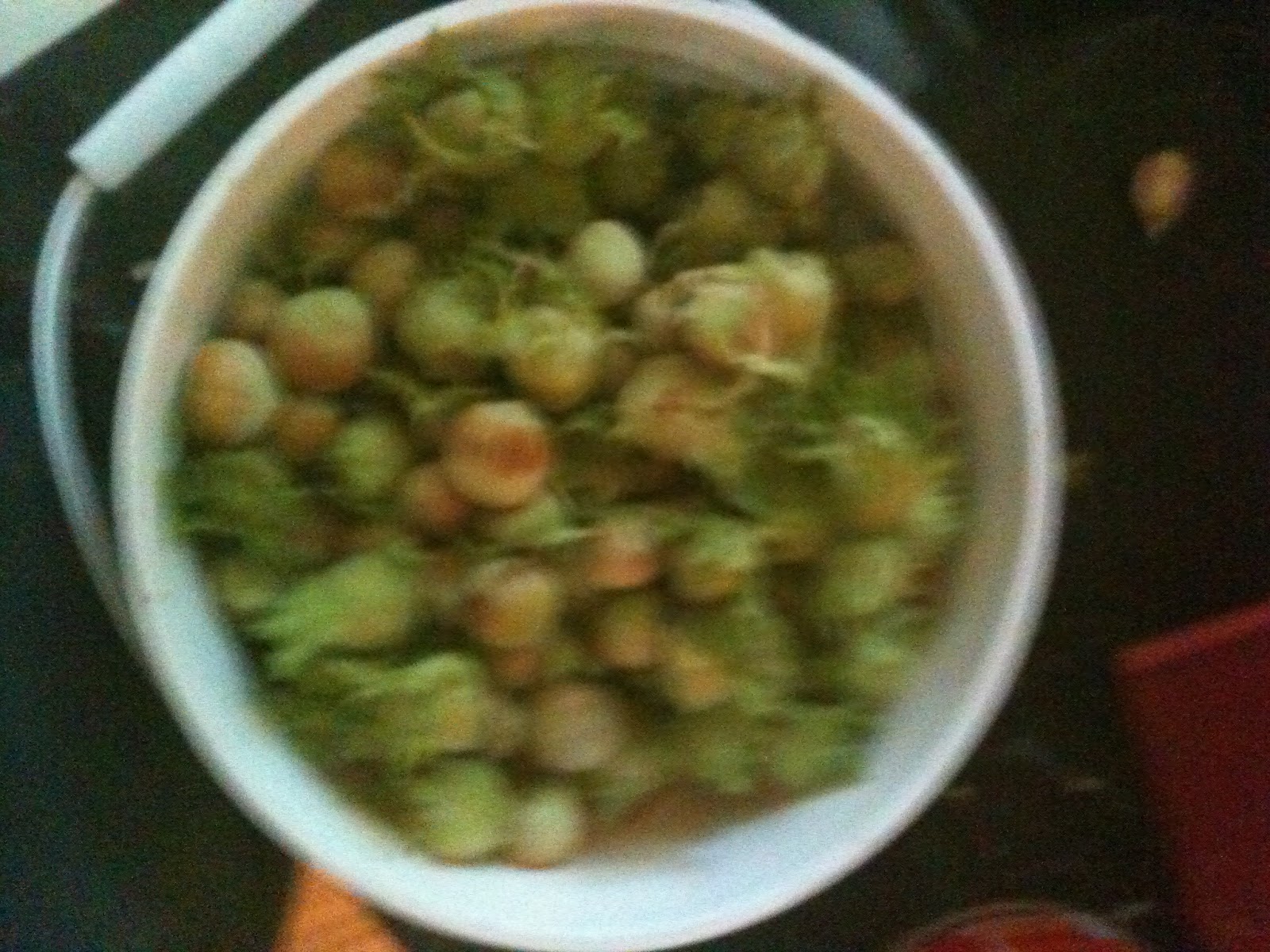
We are trying to harvest hazels this year, for the first time. Usually by the time I decide they are ripe, the squirrels have taken them all. This year I am picking them green but loose in the husk. It will be a few weeks before I know if the meat shrivels up and is ruined or if it is edible. Good nut and seed crops are one of the big gaps in production at Several Gardens Farm. We will never meet our caloric needs with our nut crop, but a harvest will help us make at least a few more meals from entirely farm-grown food


Litter of nut husks - a squirrel has been here!


 Note - squirrels leave lots of apparently intact hazels scattered around the lawn. Nearly all are "blanks", hollow  inside. 

It is a total waste of time to gather these dropped seeds and open them.The good ones are either eaten in situ, the empty shells dropping down to form a mulch beneath the plant, or dragged off and  buried, where they will sprout a few years later.

A good nut
A blank