Saturday, January 18, 2014

New plans for the wet meadow

Last summer, I told the story of our seasonal wet meadow and how I am in the process of turning it into a pollinator garden, full of nectar flowers and small habitats for wildlife. With winter flooding, the soil was partially submerged for several months each year.

Our ducks ripped up the grass, leaving it in very ragged shape for a lawn, but inspiring the idea of creating a seasonal meadow of flowers and grasses that could survive in wet soil.


Then things started to change, and threw my plans into disarray.


We no longer have ducks. 

Our chickens seem to be predator-proof, but the raccoons were much better at getting ducks. At the same time we were realizing we couldn't protect our ducks, we also realized we couldn't clean up after them. We found a more secure and better adapted home for the remaining part of our flock.

The west coast is experiencing a very dry winter. 

So far the seasonal pond has not happened. The ground is not only above water, but the soil is dry enough to work in. And since this winter has been mild as well (sorry, Polar Vortex suffering friends), I have been out working every weekend that I can.

The grass. 

It grew back with a vengeance! A lot of the mulch I used was partially composted hay. Well - hay is grass or alfalfa, and it has seeds. The grass seeds, and a lot of most unwelcome thistle, germinated and grew into huge, coarse leafed clumps.

Instead of this
I had this


So I've been going out a little every weekend and pulling grass, thistles and weeds.

 They make a nice, satisfying heap.

The green compost bin in the back - a sort given out by the city of Seattle, is full of grass and roots.

Once I filled it I started piling off to the side, just to get it out of the way.

Ultimately I lashed together some pallets with baling twine and made a nice, big compost bin. It makes me very happy to fill it. 


I can't wait for all the compost I will have this year.


With the moist but not saturated soil and the pleasant weather, gardening has been great. And the very early dusks keep me from working so late I end up aching the next day. I could weed until I keeled over if something didn't stop me. But I can't make valid garden decisions without light.


I try to spot the crowns of all the perennial meadow plants from last summer.

Some of them are surprisingly green and lively in the bare soil.

This is coming up where the brown eyed Susans were growing; I assume that's what it is. There were four or five times as many crowns as I put in plants.

So either I'm wrong, or it's growing like gangbusters.
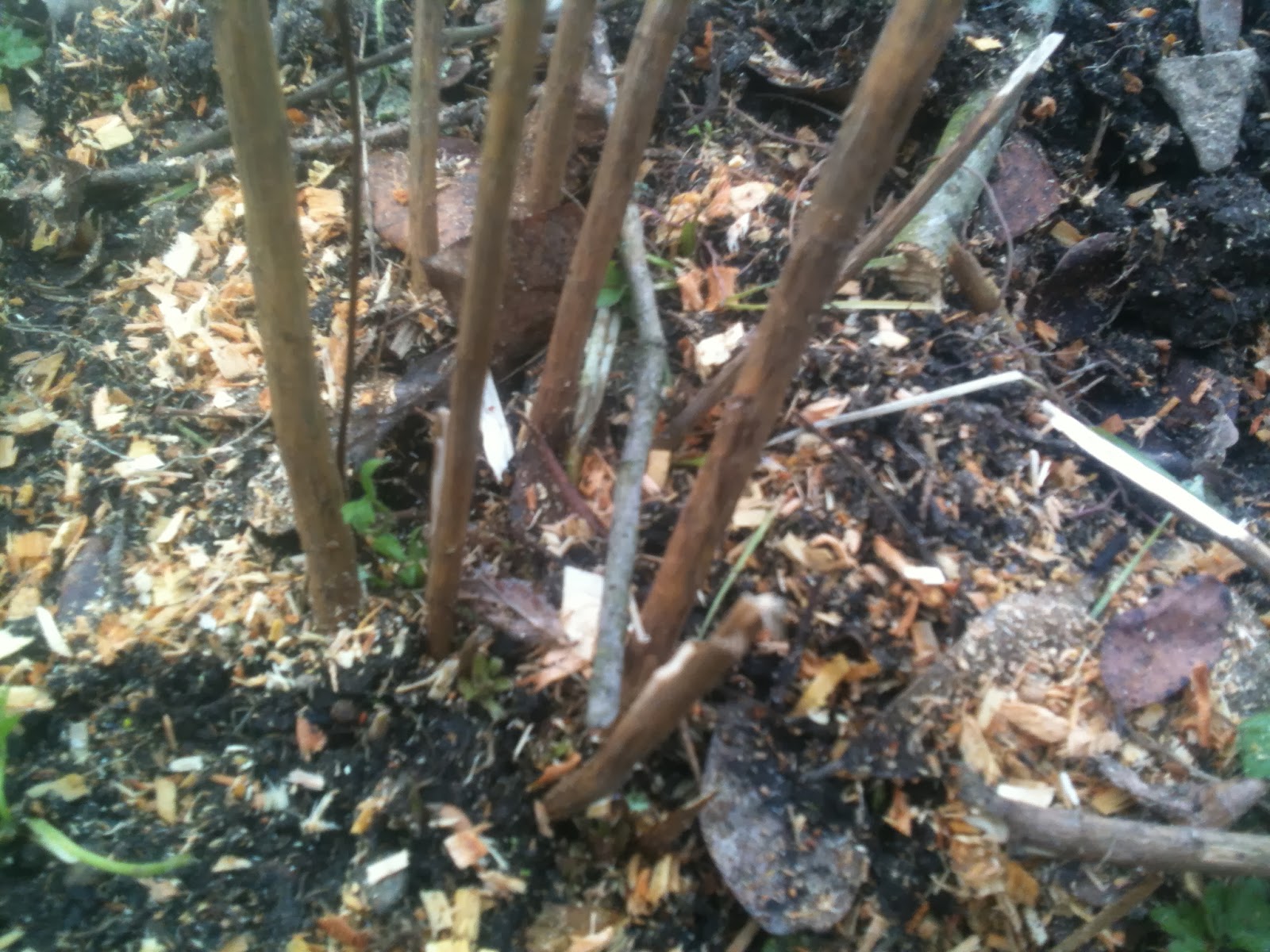


But other times a plant's crown just nudges up through the soil, hard mounds just above the soil line, with a cluster of dead stems at the top.


Other times a shiny green or pink Vee sticks up between the dead litter, indicating dormant growth below. 


Sometimes I  find plants as I start to dig a root and realize it's not a grass or a buttercup but something more intentional. Once it was a long, red, hairy underground stolon. Stinging nettle. Ooops.


This year, the Seahawks happened. But sometimes while I worked, I'd listen to the neighbors television blaring out a  game and I'd be so caught up in planning this summer's garden, I wouldn't go inside and watch. Anyway, I can get the gist from hearing it. Just pretend it's a radio. 

Other times, the high school students in the house behind would be practicing for a band they play in. I can't hear most of the instruments, just the endless drum machines and sometimes a Mariachi style accordian . Easy to tune in and out of.

I let my brain start planning next year's garden. It's in the shade of a big, sprawling pussy willow next door. I like shade, especially damp shade. I dream of big, dark leafed plants - maybe some giant Solomons seal. Meadow rue. Some trillium. Lots of dainty things to contrast with the vibrant music, the sound of football. 

And then this:


A huge windstorm blew down the willow. It must have happened last Sunday but I was too busy with my own stuff to notice till today. They had already chopped it up.


 It had fallen over the fence onto our bushes too. Luckily I can't say I was very attached to any of them. I did like the shade though.

The soft soil was trampled with huge, deep footprints. It was damp enough to compact, though not wet enough for water to cup in the deep places.


 There was sawdust, broken branches and debris all over the place.


Then I noticed someone looking over the fence at me.


Suddenly I wasn't grousing about the neighbors tree any more. I was hanging out with their little black chihuahua and his new buddy. They are two of the cutest dogs I know!

After a while our neighbor Noe came out and told us about watching the tree fall in the windstorm. He said it was a wake up call to him and his family. They are going to look for other hazards in their home, and make an emergency plan for future disasters. He was sorry about the fence. 

I said not to worry. A fence is just a fence. Suddenly that seemed so minor!


I wish I'd taken a picture of the meadow after I completely degrassed it, to prove that it really happened and show how hard I worked. But I thought I could do it later, and then later a tree fell on it.

Here is a pile of torn up grass in the background and some wood chips from the tree in the near ground.

The story about how I worked on the yard just changed. It's not the story of all the work I did and it's not the story of how it turned out. I will tell them another time.

It's not the story of how I was frustrated at having a tree fall on my fence, and my soil stepped on, because I got over it. It's not about pollinators or biology or plants or anything.


Its just a story about gardens and shade and rain and dogs and trees and neighbors and making plans and unmaking them again, as sometimes happens.


Such is life that you never know when a willow tree will fall onto your work and leave wood chips and ivy fragments all over it. You can't plan for a dry year, though with climate change ahead I should plan on less freezing each year. You can't plan which windstorm will kill a tree, but you can make a shrewd guess which trees are most likely to succumb and you can recognize that it's better to fall on a fence than on a house.

You can enjoy work, and listen to games, and you can remember that distractions, redirections and changes of plan aren't just sidelights -they are life, happening. Live it and enjoy.

Shared on: from-the-farm-blog-hop , frugal-days-sustainable-ways

Monday, December 9, 2013

Cosmo the cosmic rooster

 This morning when I went out to feed the animals, the goats came running out to greet me as usual, and the hens were all spread around the yard, scratching for food or seeking water. There was ice on all the buckets and they were more excited to get warm water with a little molasses than they were to eat.

But I couldn't' find Cosmo, our little rooster.

We got Cosmo about eleven years ago. Noah was a baby, and had a terrible stomach bug. I brought him back from the doctor and suddenly I knew I was sick too. We were sick all that day and all night. David got sick too.

The next morning I dragged myself out to feed the chickens, and saw that a dog had killed all but one of them.


We were of course very upset. We asked around but no one knew whose dog had done it.

But some kids were eager to help us get back up and running with chickens.

They gave us three hens and a little rooster.

My original plan to get rid of the rooster within twenty-four hours never panned out.

We kept him ever since.


When you talk to people about roosters there seem to be two main groups of rooster, the Fred Astaire variety and Jack the Ripper. Breed has nothing to do with it, this is a matter of style and manner.

At his best, a rooster is a huge asset to the farm. Roosters can be extremely brave. They walk up to people and animals. If they are raised to be trusting, they will walk up to people without fear but also without malice. They are often more cuddly than hens. When Noah was tiny - maybe three - he followed me out to the yard while I did chores.

When I turned around to check on him, he was holding Cosmo in his lap and slowly plucking his tail feathers out one by one. Cosmo sat so still and calm, I don't think Noah was even aware of hurting him. I had seen Noah with cats, chickens and dogs - all of which, though gentle, would bat him, peck, or at least try to escape. Nope, Cosmo just stayed put. I had to watch them together till Noah learned how to not walk around with him, because if he fell Cosmo wouldn't even try to jump to safety.


A good rooster is chivalrous to the hens. When he finds food, he coos and clucks for the hens.

Cosmo could spend several minutes strutting around with a worm in his beak, making trilling sounds to attract the chickens.

He would pretend to drop it and pick it up, pantomime eating without actually doing it.

Whatever he finds belongs to his flock.


 A rooster must also understand how important the egg laying job is to the hen.

Cosmo would find nesting spots for the hens. Here he is nesting in some hay, wriggling around to mold it into a nice, soft, solid feeling cavity where anyone might feel safe depositing her precious egg.

He would sit with the hens while they worked on their eggs. When they hopped out of the nest, he would cock-a-doodle to the rest of the flock so everyone could get back together.

Sometimes I would see him walking with one of the hens, stretching his tiny legs to keep up with them.


His goal in all of this, of course, is to obtain the hens favor and to help her raise eggs that carry his genes.

To do this, a rooster needs to court the hens. Cosmo would prance in circles around a hen, flashing his wings up and down and holding his head very high.

Some of the hens would crouch down and offer their charms to him. Others would walk away disdainfully. Cosmo always took that kind of snub well. Perhaps having so many hens, he always knew he could try someone else.

Of all the eggs he may have been involved in, only one ever hatched into a chick.


Laura - AKA Lauren - and later the Bantam Menace - was a rooster firmly grounded in the Dark Side of rooster manners.

He would run at Noah, claws out, and scratch his legs and hands. This was even though Noah had by that point learned to be gentle with animals, and anyway never got close enough to The Bantam to be a threat.

He pinned down hens and had his way with them. He was fine with goats unless they made sudden moves. Then he would flash out at them with his spurs and scratch them as if they were other roosters.

And his dad - he persecuted Cosmo day and night. He would chase him out of the barn, out to the fence line, and sometimes over the fence into the neighbor's yard or even the street. We don't have Lauren the Bantam Menace any more. He was my first experience with understanding how people become hardened to butchering their own meat animals.


Along with being good to hens and gentle with people, Cosmo had a fearlessness with anything in the form of a predator. When cats, or the one dog I saw him around, got into the yard he would always walk past them making a special call, half alarm, half shrill wail, and draw them away from the hens. He didn't usually stand his ground and fight them, more diverted them while the others got away.

When the hens went up to the roost, he would stay on the ground till the last lady got up.


But he had an uncommon talent for knowing which animals were safe. Like many birds, he liked to rest on top of goats. I think it keeps their feet warm.

Cosmo outlived a whole generation of goats, and two or three generations of hens. At nearly twelve, when he wan't on the perch this morning I assumed the worst. I looked in the treehouse where the Raccoon brought the duck it killed, but there were no scarlet feathers.

I checked the kidding shed where Jeannette used to hang out, but he wasn't there. I didn't see him on the hay bales in the garage, or in the tall grass by the fence line. After a while I gave up. I had to go to work, and I reasoned, if he is alive, he's ok. If he died, I can't help him. If anything hurt him at night, the cold will have already finished him off. I really can't do much to help him. I resolved to write his obituary if he didn't come home, and dedicate a blog story to him if he did.

When I got home, he was up on his roost. Old, but since roosters don't go grey, he will live however many days are left in all his fiery beauty and all his gentle good nature.


Saturday, November 30, 2013

Water everywhere

It's been a long couple of weeks at Several Gardens Farm. A raccoon got into the yard and killed  some of our ducks. The second time it was there, I woke up to the sounds of it and ran out to catch it in the act. I should have just let it finish. Their instincts make them want to kill. Mine make me want to help, and this time there was nothing useful I could do but help the duck to have a speedy ending.

Before it happened I had already, sadly, acknowledged that I was not good with ducks.

They were messing put all the other animals' water. The soil was pocked with their bill marks and churned up into smelly mud.

I loved having them but I also hated and dreaded it. I had found a home for them a few weeks earlier, balked - but now I called them back and asked them to give the remaining ducks a safer and more adapted home.


Then I turned to the yard and started restoring it to its pre-ducky, dry, fresh smelling, state. Don't get me wrong. In rainy Seattle, its uphill work to keep a barnyard dry, and there are days in winter when the chickens and the goats stay inside, pooping where they are. It's worst on days that hover just above freezing, when the animals stare out at the sleet, and you can see their breath condensing on the nail heads in the walls. The humidity seeps in through the floors and the hay gets damp and droopy and the walls weep and the plywood roof develops a discolored spot where it's weakest and everything seems to groan and age beyond years.

But all of that is just the normal, sad winter mood. The ducks brought an extra layer to it - the smell of fishy wet poop and the frustration of birds that can't climb and are constantly underfoot with the goats. The ducks pulled the hens tails when they stuck out the the nest boxes. The seething, sexually insatiable drake hassled ducks and chickens alike, and the distress of the tiny rooster trying to ward him off and defend the flock. It made the goats nervous and the chickens frantic.

We got a glorious summer this year; with virtually no precipitation from early July until mid September. We had a gold and orange autumn, with crisp days, and sunshine enough to ripen a decent grape harvest.

But starting in November, a sort of amnesia kicks in. It feels like it never started raining and will never end. Now a sad calm reigns, but the wet smell of waterfowl lingers.

First off, even before we had ducks, the drainage in the barnyard was never ideal. The drip line from the sheltered feeding area always formed a muddy puddle, and the downspouts at each end of the barn created two more mud pits. Mud is anathema to goats' hooves. Imagine walking barefoot. In mud. Cold mud where you also had to poop. Imagine cold, grainy mud wedging not just between your toes, but up under your toenails, all winter long. This is exactly what a muddy barnyard does to the goats, until eventually it can cause foot rot, peeling hoof walls and all other manner of foot woes.


In winters past, we put concrete pavers out for them to tread on, but the ducks digging around in the mud would gradually work the pavers down into it so that they eventually buried them completely.

I've also added yards and yards of cedar play chips (expensive but great) and free arborist chips (free and sometimes worth it). Cedar decays very slowly but it, too, can get buried over time.

This year we decided to add real drainage.

The barn is at the top of a very gently terraced orchard, running down through a series of swales to the back, where a seasonal pond forms every winter and lasts till April or May. But while it works on a big scale, the ground gets pretty soggy day to day. Before there were animals, no one cared, but now we need something better.


Naturally, a tractor was involved in this project.


We set about adding drainage at the wrong time and in the wrong way. We planned to go out of town, leaving the house with the goat sitter. Instead of deciding it would wait till our return, we were suddenly seized with the need to get the place drained before the sitter got there. This meant we had a 24 hour deadline, which didn't include both of our jobs, feeding the kid, the animals being underfoot, etc.


So please excuse the pictures. There were a bunch of times when I just didn't feel right asking David to stop for a photo.

When I looked at my pictures later there were a lot of blurry action shots and a huge number of pictures of small rocks at night, or small rocks nestled into mud. You'll get to see some of them in a moment.

And there are no photos of me doing anything but I will vouch that I was down  in the trenches too.

I went through four pairs of work gloves and two pairs of pants. David even changed once. His insulated Carhartts got so heavy with mud he was actually finding them uncomfortable. That never ever happens and is testament to what a job this was.


I think what we installed qualifies as a French Drain. It is not a drain to save our basement or keep a structure intact so in one sense it was less critical, but we put a lot of work and a lot of pebbles into the ground so we did our best to build it to work.


First we dug a series of deep, long trenches, running from the spot where the water accumulated to a spot lower in the yard. We kept the trenches sloped so they would act as ditches to run the water away from the house. The tractor was very handy for this.

It is a good digger but it didn't have a way to level the trenches, so we ended up down in them, raking the sandy soil from one place to another.

Seattle has some pretty interesting geology. We have areas where glaciers swept the place clean, and areas where glaciers left rocks and debris, and one yard can have both. Luckily we had mostly sand with rocks the size of a tennis ball or smaller, so there was no really serious hauling of stone.


Our main concern was to have the trenches point downward along their run. The last thing we needed was for them to direct water back up toward the barn.

At the end of the trench we dug a dry well, a deeper area where extra water could go.


This is the despair photo. I seem to have one in every project, a sort of mid point where I regret ever starting and look around at nothing but devastation. Tractor tire marks in the grass. Cut up PVC pipe all over the place. Mud, muddy concrete and muddy water buckets for the animals. Despair.


At some point in the process, we hit a water line. We knew it was in there but it's not on any records anywhere so we didn't know when or where we'd find it. Alas, we found it by creating a geyser.

Luckily we have a very good hardware store fairly close to the house, and David is a very patient and resourceful guy who just fixes things instead of pitching a fit. He picked up pizza on the way home and we got a little break.

By the time we set the PVC pipe in place and added T's to get to the water along the concrete pad, it was completely dark and getting chilly.

Luckily we have a big overhead barn light to work with, but unfortunately I don't have a flash.


So believe me when I say we laid out filter fabric, poured a bed of crushed gravel into the trenches, and set the pipes on top of their nice bed.


Then we filled in the rest of the trench with more stone, placed more filter cloth on top and covered it all up with the excavated soil, which was by now soaking wet from the earlier waterline break and the gentle, bone chilling rain. 

In all we went through two yards of gravel, and could have used more if our truck had been up for it. As it was, it took two trips and we were pretty seriously dragging with each load.


 A very strange thing happened near the end of this stage.

When we refilled the trenches, there was not enough soil to fill them. This flew in the face of all math. We had dug out trenches and filled them with rocks and pipes. They should have been too full and formed mounds, but instead they were slightly sunken.

They were also, due to the huge amount of mud we had churned up, a worse mess than when we started.

Sometimes the solution to a problem really is to go to bed. By the next morning, the water had sunk down through the soil, leaving ordinary damp dirt without puddles. That night - our last before catching our flight - we filled in the top with lovely, fresh smelling cedar play chips, another two yards.

The yard is now safe for the foot of man and beast. The sitters appreciated the nice clean walking surface and probably the pleasant smell. When we get a chance we will add a few pavers and perhaps another yard of chips. All that will be icing. The big news is the yard will be free of puddles.


That's a pond in the corner, not a really big accidental puddle, BTW.